


One of the most frustrating things about having a dog is when your dog pulls on the leash while you're walking him. Good leash etiquette is essential for an easy and safe walk. Perfect following is not required, just that the dog pays close attention to the owner.
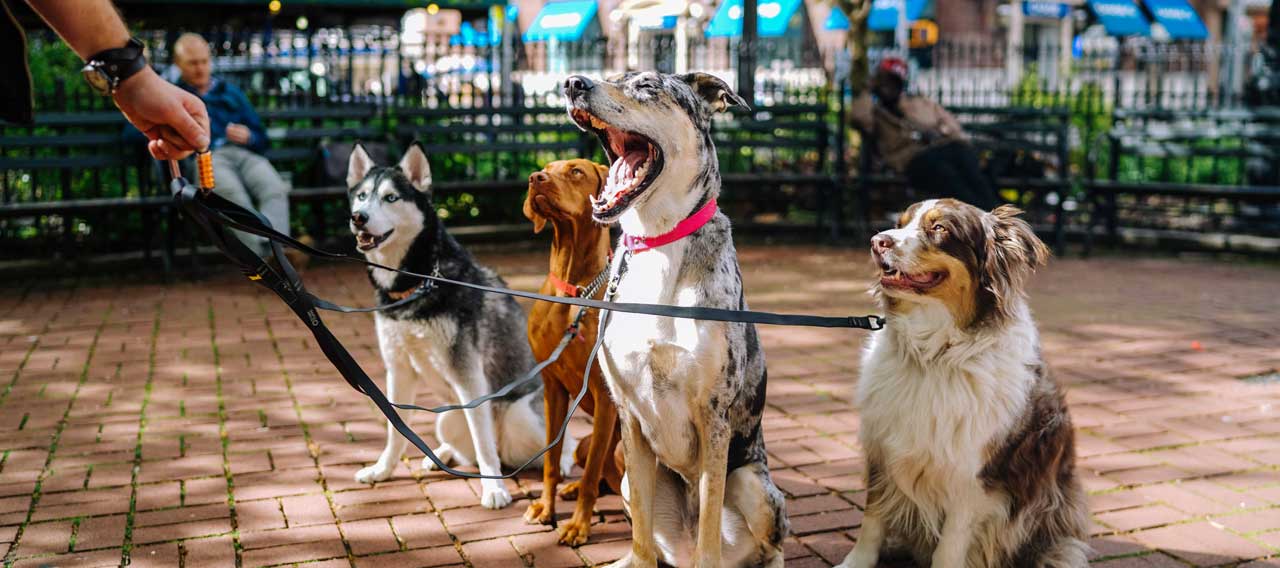
Equipment
Part of successfully training a puppy or dog to walk on a leash is understanding the equipment available. Not every dog will respond to every collar type or leash length. Be consistent over a period of time, and if your efforts aren't working, try a new tool to get the job done.
Leashes
Leashes come in a variety of materials and lengths, from short 18-inch leashes to long 100-foot leashes. Very short leashes are best for dogs that have been trained to walk at a proper heel pace, but otherwise can be a bit restrictive. Very long leashes are best for parks and open areas where dogs can't be off-leash and need to be trained to come when called. Leashes between 15 and 100 feet long have plenty of room and the ability to pull the dog back if needed to reinforce a recall.
The most common materials are nylon and leather. Both of these materials are fairly light and sturdy, and can withstand the occasional chewing or tripping. If your dog has a bad habit of chewing on the leash, it's best to use a chain link leash until he can be trained out of this bad habit. A strong leather dog lead is nice and strong, and if properly maintained, it will last a lifetime.
Roll or Flat Collar
The most common type of collar you will see on dogs these days is the common flat or roll collar, which is secured with a buckle or plastic clip. These collars are convenient, easy to put on and take off, and can be used to hold a dog's identification tag, proof of rabies vaccination, and county license. These collars can be dangerous for dogs that tend to pull. It can cause eye pressure and swelling, so dogs with glaucoma or other eye pressure problems may be at risk with flat or roll collars.
Martingale
A martingale collar, unlike a flat collar, has an extra loop that tightens when the leash is stressed. This is not for correction, like a choke collar, but to prevent the dog from slipping off the collar and running away. At its tightest, a martingale collar should be adjusted to not accidentally strangle the dog. These collars are perfect for those Houdini impersonators who can get away with any collar.
Choke Chain
Once, choke collars were the only collars for training dogs, but they were easy to use improperly and rarely worked optimally. Now that professional trainers are moving heavily toward positive reinforcement rather than yanking on the dog's neck to correct, choke collars have fallen out of favor. The purpose of using a choke collar is to teach the dog that when it misbehaves, it will be punished harshly. Therefore, lighter punishments may be sufficient because they serve as a reminder that a more painful punishment is coming.
Prong Collar or Pinch Collar
Pinch collars have been around almost as long as choke collars as far as training tools go. Traditional trainers like to call it power steering; you don't need to use as much force as a choke chain to have an impact. Although it may look like a torture device, it may be safer than a choke chain. It puts less pressure on the neck during a hard yank. However, there is still pressure on the neck, so this type of collar may suffer from the same problems that previous collars may cause.
Basic Harness
Harnesses have several advantages over collars. While it's not recommended to wear a harness all the time, not all collars are suitable. Other than that, harnesses are a great tool for training puppies and older dogs. Harnesses give the trainer more control than collars, which is especially useful in crowds or on busy streets. Harnesses prevent small dogs from getting injured by pulling on the collar; harnesses spread the pressure over more parts of the body, reducing stress on the back and neck, and preventing pulling.
Front-Hitch Harness
A variation on the basic harness, the front-hitch halter discourages the dog from pulling further by diverting its attention. Some dogs learn to pull more with a rear-hook harness, whether due to a breed tendency like spitz and malamutes, or simple individual stubbornness. A harness hooked in the front causes the dog to turn when he tries to get ahead and lunge forward. This limits the dog's forward movement, teaching the dog that the only way to get anywhere is to follow the trainer.
Head Collar
A head collar, or head halter, is useful for trainers who want to speed things up while still keeping the dog's attention. Once the dog has learned leash etiquette, it can be switched back to a basic collar. The principle of a head halter is the same as for horses trained with the same equipment: the animal's body, no matter how large, will move in the direction the head is pointing. Dogs are most focused when their attention is on their trainer; with a head collar, it's easy to get your dog to turn his attention away from any distractions and back to you with just a gentle squeeze. The downside is that dogs need to be trained to like wearing a head collar. However, positive, repeated associations with walks and treats should yield great results.
Using the Equipment
Introduction
Initially, you need to get your dog used to wearing the equipment you plan to use. Let your dog or puppy wear it for a short time in the house at first. Play with your dog and give them treats so they associate the equipment with positive things. Dogs should enjoy leash time; it should represent fun and food.
Tips
This is a basic step in training any desired behavior: teach your dog that a certain sound means food or treats are coming. Some people use a clicker, others smack their lips. Using words like "good" or "yes" is also popular. Whatever the tip, the method is the same: Put your dog on leash in a quiet, distraction-free area and make a sound. As soon as the dog looks at you, give the treat. Soon the puppy will come to you for the treat.
Tempt you
When the dog walks toward you on the leash for the treat, step back a few steps and then reward it when it arrives. Keep initial training sessions brief so as not to over-stress the beginner's attention span. Continue to progress until the dog walks toward you on cue and then walks a few steps with you.
Work indoors
The dog now understands that the sound means approach and a few steps will be rewarded. Practice walking the dog on the leash for a few steps each time, praising and rewarding the dog for good behavior. This is easier to do indoors because distractions are limited. At this stage, the dog will still find the device distracting enough, so don't rush to take it outdoors.
Take it outdoors
New challenges await you the first few times you take your dog outside. Dogs will naturally focus on a lot of sensory input, and your task is to keep the dog's attention focused on you. If the dog's attention wanders away from you or it looks like the dog is about to pounce on a distraction, give the cue sound and continue walking a few steps, rewarding the dog for following you with praise and a treat.
Practice & Troubleshooting
Everyone wants their dog to be perfect, but there can be some bumps in the road to developing good leash habits. Being able to walk on a relaxed leash with absolutely no lunging or pulling is the ideal goal. These troubleshooting tips will help practice perfect good leash habits.
Pulling
If the dog starts pulling in another direction, stay rooted in place like a tree. Stand completely still and refuse to move until the dog is back to you. Don't give in to the temptation to jerk or tug on the leash, or drag the dog in the direction you want it to go. Remember to use tools like head collars and front clip harnesses to combat pulling issues.
Lunges
If the dog lunges at something while you're walking, the key to correcting it is to be prepared. Whether it's another dog, a car, a pedestrian, or a cyclist, redirect the dog's attention back to you with a treat before the dog actually lunges at you. This requires close observation of your dog's cues and behaviors, and asking the dog to pay close attention to you. Be proactive.
Barking
Some dogs tend to bark at distractions while on a walk. This is often a behavioral problem caused by lack of exercise. Dogs need physical and mental stimulation, and some breeds need more than others. Particularly intelligent breeds can get bored easily and react to outside stimuli if they don't get enough physical and mental exercise. If barking is still a problem despite providing adequate exercise outside of walks, such as tug-of-war and fetch games, assume the dog is lunging at things: create space, then offer treats to distract the dog before it starts barking.
Ideal Leash Etiquette
Loose-leash walks are the ideal way to practice good leash etiquette. This requires both the trainer and the dog to be alert. This is great for bonding because you both need to pay attention to each other. Good leash etiquette is also important for safety. A dog that misbehaves on leash can be dangerous to you, your dog, other people, and other dogs. Some dogs can become nervous or aggressive when not properly trained on leashes and other equipment. Encourage good leash etiquette for the safety of all involved.
Leash etiquette is an important part of training your dog. Keep training sessions short and frequent, taking care not to over-tired the dog. Be consistent in your training and make it clear that pulling is not allowed. Make this clear at every training session. Try walking quickly when training so your dog is more focused on the walk and less inclined to pay attention to external stimuli. Be consistent and proactive when training, and enjoy the time you spend bonding with your dog.